By Drake Miller – Senior Content Manager and Academic Strategy Consultant
The academic landscape in the United Kingdom has undergone a seismic shift. Between the rigorous standards of A-Levels and the intensive modular structures of Russell Group universities, students are facing unprecedented levels of deadline pressure. The “all-nighter” fueled by energy drinks is increasingly being replaced by sophisticated, science-backed productivity frameworks.
Whether you are navigating Sixth Form in London or finishing a degree in Edinburgh, mastering your workflow is no longer optional—it is a survival skill. Many students now look for reliable assignment help online to balance these heavy workloads. Here are the top study hacks currently trending across UK campuses to help you beat the clock and maintain your mental well-being.
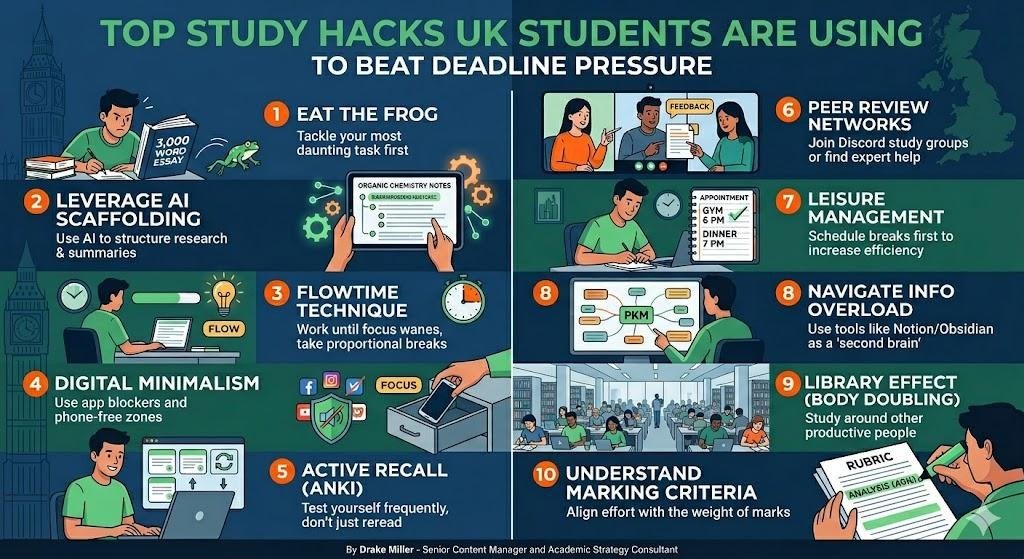
1. The “Eat the Frog” Method (UK Edition)
Mark Twain famously said that if you eat a live frog first thing in the morning, nothing worse will happen to you the rest of the day. In an academic context, your “frog” is that 3,000-word sociology essay or the complex organic chemistry problem set you’ve been avoiding.
UK students are increasingly using the first 90 minutes of their day—when cognitive load capacity is at its peak—to tackle their most daunting task. By clearing the hardest item off your UCAS or university checklist early, you eliminate the “background radiation” of anxiety. If a task feels truly insurmountable, you might even decide to pay someone to do my assignment to ensure that one specific “frog” doesn’t derail your entire semester’s progress.
2. Leveraging AI for Research Scaffolding
One of the biggest hurdles to meeting a deadline is the “blank page syndrome.” High-achieving students are now using Agentic AI and Large Language Models (LLMs) not to write their essays, but to scaffold their research.
Digital literacy is the new gold standard. Use AI tools to generate comprehensive outlines, summarize long academic journals, or explain complex theories like Keynesian economics in simpler terms. This allows you to move from “searching” to “analyzing” much faster. If you find yourself stuck on a technical hurdle, seeking specialized biology assignment help or expert guidance can provide the clarity needed to keep your project on track without missing the submission window. The goal is to use technology to enhance your critical thinking, not replace it.
3. The Pomodoro Technique 2.0: Flowtime
While the classic Pomodoro (25 minutes on, 5 minutes off) is well-known, many UK university students are pivoting to the “Flowtime” technique. The strict 25-minute timer can sometimes break a state of “deep work” or “flow,” which is counterproductive for intense dissertation writing or complex problem-solving.
With Flowtime, you start a timer and work until you naturally feel your focus waning. You then record how long you worked and take a break proportional to that effort (e.g., a 15-minute break for 60 minutes of work). This bespoke approach respects your brain’s natural rhythms and is particularly effective for long-form writing and coding projects where “getting into the zone” takes time.
4. Digital Minimalist Study Spaces
The average student picks up their phone over 90 times a day. To beat deadline pressure, UK students are adopting “Digital Minimalism.” This involves:
- App Blockers: Using tools like Forest or Freedom to lock social media during study hours.
- Grayscale Mode: Turning your phone screen to grayscale to make the UI less dopamine-inducing.
- The “Out of Sight” Rule: Leaving the phone in a different room entirely.
When the deadline is 11:59 PM, every notification is a potential derailment. Modern libraries across the UK are now seeing a rise in “phone-free” study zones to help students maintain this discipline. Removing the temptation is always more effective than relying on willpower.
5. Active Recall and Spaced Repetition (ANKI)
Rereading notes is the most common—and least effective—study habit. Top-tier students in the UK are moving toward Active Recall. Instead of looking at information, you force your brain to retrieve it.
Apps like Anki or Quizlet, which utilize Spaced Repetition Systems (SRS), are becoming staples for A-Level and medical students. By reviewing information at increasing intervals, you move knowledge from short-term to long-term memory, reducing the need for frantic “cramming” the night before an exam or final submission. This ensures that your knowledge is deep-seated, which is vital for the synoptic questions often found in UK exam boards like AQA or Edexcel.
6. Utilizing Peer Review Networks
In the UK’s collaborative academic culture, “study grams” and Discord study servers have exploded in popularity. Explaining a concept to a peer is one of the fastest ways to solidify your own understanding (The Feynman Technique).
If you are struggling with a specific module and your peer group is equally stumped, professional platforms allow you to do my assignment online by connecting with subject matter experts. This ensures that even when a topic is exceptionally difficult, you have a roadmap to follow to complete your work accurately and on time. Collaborative learning, whether peer-to-peer or expert-led, is a hallmark of the modern British academic experience.
7. The Power of “Leisure Management”
It sounds counterintuitive, but the students who beat deadlines most consistently are those who schedule their breaks first. “Parkinson’s Law” states that work expands to fill the time available for its completion.
If you give yourself all day to write a conclusion, it will take all day. If you schedule a gym session or a meet-up with friends at 6:00 PM, your brain naturally becomes more efficient to ensure you meet that “hard stop.” Strategic rest prevents burnout and keeps your cognitive processing speeds high, allowing you to produce higher-quality work in shorter bursts.
8. Navigating Information Overload
We live in an era of information surplus but insight deficit. When researching for a thesis or a major project, the sheer volume of UK parliamentary papers, JSTOR articles, and news archives can be overwhelming.
Modern study hacks involve using “Personal Knowledge Management” (PKM) tools like Notion or Obsidian. These tools allow you to link ideas together visually, creating a “second brain.” When it comes time to write, you aren’t starting from scratch; you are simply assembling the connections you’ve already made. This reduces the “decision fatigue” that often leads to deadline procrastination.
9. Optimized Environment: The Library Effect
There is a psychological phenomenon where being around other productive people increases your own productivity. This is why university libraries like the British Library or the Bodleian are always packed during term time.
If you can’t get to a physical library, many students are using “Study With Me” YouTube streams or “Virtual Libraries” on Zoom. Seeing others work creates a social contract that encourages you to stay in your seat and finish your tasks. This “body doubling” technique is highly effective for students who struggle with solo motivation.
10. Understanding the Marking Criteria
Finally, a hack that is often overlooked: read the rubric. Many students lose hours perfecting sections of an assignment that carry only 5% of the marks.
In the UK system, the marking criteria (Learning Outcomes) are your cheat sheet. Align your effort with the weight of the marks. Focus your “Deep Work” sessions on the analysis and evaluation sections, which typically carry the highest weight in A-Level and Degree marking schemes. Understanding what the examiner is looking for is the most direct path to a First-Class result.
Frequently Asked Questions
Q.1 What is the best way for UK students to manage multiple deadlines?
The most effective method is using a “Master Calendar” that visualizes all deadlines for the term. Break these down using the Eat the Frog method, ensuring you tackle the most complex or high-weighted assignments during your peak energy hours.
Q.2 How can I stop procrastinating on a 3,000-word essay?
Start with “Research Scaffolding.” Instead of trying to write the essay, focus on creating a detailed outline or summarizing three key sources. Breaking the task into micro-goals makes the project feel less daunting and helps bypass the initial resistance to starting.
Q.3 Are these study hacks applicable to A-Levels as well as University?
Yes. While university students often have more independent study time, A-Level students can benefit immensely from Active Recall and Spaced Repetition to manage the heavy content load of the UK national curriculum.
Q.4 What should I do if I’m struggling to understand a specific UK module?
Don’t wait until the week before the deadline. Utilize peer networks, attend tutor office hours, or use professional academic platforms to do my assignment online with expert guidance. Early intervention is key to maintaining a high GPA or UCAS standing.
Conclusion: System Over Sweat
Beating deadline pressure isn’t about working harder; it’s about building a system that makes failure difficult. By integrating modern technology, respecting cognitive science, and knowing when to seek expert assistance, UK students can navigate their academic journey with less stress and higher results.
The next time you see a daunting deadline on your calendar, don’t panic. Pick a “frog,” set a Flowtime timer, and start building your path to success.
About the Author: Drake Miller is a senior content manager and academic strategy consultant with over 12 years of experience in the higher education sector. Based between London and Sydney, he specializes in the ethical integration of Agentic AI and digital literacy into student workflows to enhance academic integrity and success.