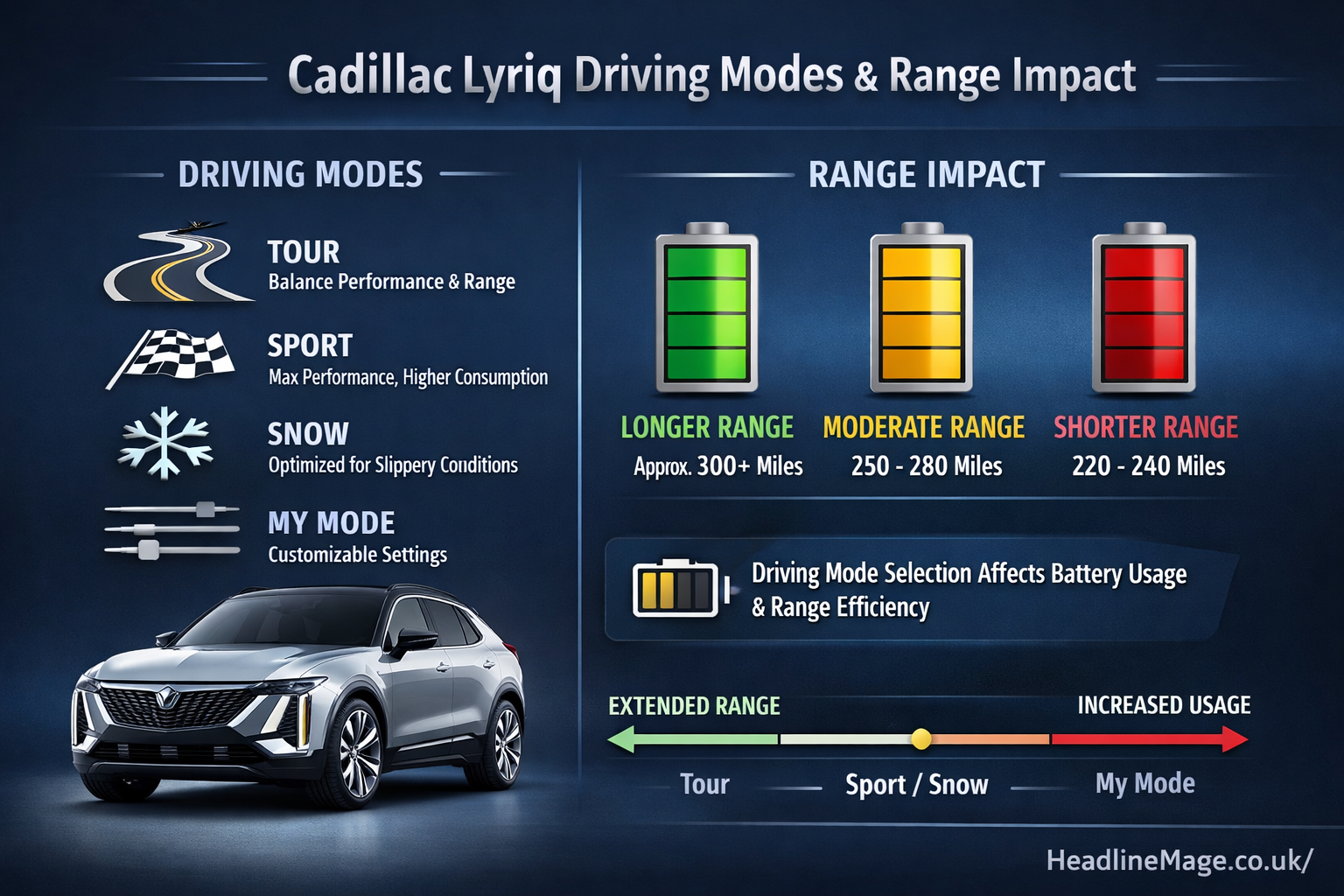
Do the Driving Modes in Cadillac Lyriq Offer Different Ranges or Battery Usages?
The Cadillac Lyriq represents a turning point for luxury electric SUVs, blending refined design with advanced software-driven vehicle dynamics. One of the most common questions new and prospective owners ask is simple but important: do the driving modes in Cadillac Lyriq offer different ranges or battery usages?
This guide answers that question in depth, cutting through assumptions and marketing language to explain how Lyriq driving modes truly influence energy consumption. By the end, you’ll understand how mode selection impacts efficiency, what actually changes behind the scenes, and how to optimize range without sacrificing the premium driving experience Cadillac promises.
Understanding Driving Modes in Modern Electric Vehicles
Driving modes in EVs are not cosmetic features but software-defined systems that adjust how power, braking, steering, and climate management behave. In the Lyriq, these modes are designed to adapt the vehicle to different driving priorities rather than transform it into a fundamentally different machine.
Unlike internal combustion vehicles, electric cars respond instantly to software changes. This means even subtle tweaks to throttle mapping or regenerative braking can influence energy flow and perceived range, which is why the question of battery usage across modes matters more in EVs.
Overview of Cadillac Lyriq Driving Modes
The Cadillac Lyriq offers multiple driving modes that balance comfort, responsiveness, and efficiency. While exact naming may vary slightly by model year or software update, the core modes remain consistent in purpose and behavior.
Each mode fine-tunes vehicle response rather than unlocking hidden battery capacity. Understanding these distinctions helps clarify whether selecting a different mode truly alters how far the Lyriq can travel on a single charge.
How Electric Range Is Calculated in the Lyriq
Range in the Lyriq is not a fixed number but a dynamic estimate based on recent driving behavior, terrain, climate usage, and efficiency patterns. The vehicle continuously recalculates expected range using real-time data from the battery management system.
This is critical context when asking whether do the driving modes in Cadillac Lyriq offer different ranges or battery usages, because the displayed range can change even if the battery’s actual energy remains the same.
The Role of Software in Battery Usage
Battery usage in the Lyriq is governed by software that manages power delivery, regenerative braking, and thermal systems. Driving modes act as preset software profiles layered on top of this management system.
Rather than draining the battery faster by design, certain modes allow higher power output or less aggressive energy recovery, which indirectly influences consumption depending on how the vehicle is driven.
Tour Mode and Everyday Efficiency
Tour Mode is designed for daily driving and long-distance comfort, offering smooth throttle response and balanced regenerative braking. It prioritizes predictability and ease of control, making it the default choice for most owners.
In practice, Tour Mode often delivers the most consistent efficiency because it avoids aggressive power spikes. While it does not explicitly extend range, it naturally supports stable battery usage in mixed driving conditions.
Sport Mode and Performance-Oriented Consumption
Sport Mode sharpens throttle response and steering feel, giving the Lyriq a more immediate and engaging character. Power delivery becomes more assertive, especially during acceleration.
This mode does not inherently reduce range, but it encourages driving behaviors that increase energy consumption. The battery is capable of supplying higher output, and frequent use of that capability results in faster energy depletion.
Snow and Weather-Optimized Modes
Snow or weather-focused modes adjust traction control, torque distribution, and throttle sensitivity to maintain stability. These changes are primarily about safety rather than efficiency.
Battery usage in these modes may increase slightly due to more frequent traction interventions, but the impact on overall range is situational rather than constant.
Regenerative Braking and Its Impact on Range
Regenerative braking is one of the most significant factors influencing real-world EV efficiency. The Lyriq allows varying levels of regeneration depending on mode and driver-selected settings.
More aggressive regeneration recaptures energy during deceleration, which can extend effective range in stop-and-go traffic. Modes that favor smoother coasting may feel more natural on highways but recover less energy in urban driving.
Climate Control and Mode Interaction
Climate control is a major energy consumer in any electric vehicle, and the Lyriq is no exception. Driving modes can subtly influence how aggressively heating or cooling systems operate.
In efficiency-focused driving, climate systems may prioritize energy conservation, indirectly supporting longer range. This interaction often matters more than differences in throttle mapping when considering battery usage.
Real-World Driving Behavior vs Mode Selection
Driver behavior consistently outweighs mode selection in determining energy consumption. Smooth acceleration, steady cruising speeds, and anticipation of stops have a greater impact than switching between Tour and Sport.
This is why two drivers using the same mode can experience very different range results. The Lyriq’s software responds to inputs, not intentions.
Common Misconceptions About EV Driving Modes
Many assume that switching to a “sport” mode instantly reduces range or that an “eco” mode unlocks hidden battery capacity. In reality, the battery size remains constant, and modes only influence how energy is accessed.
Understanding this distinction helps clarify whether do the driving modes in Cadillac Lyriq offer different ranges or battery usages in a meaningful, structural way.
Cadillac Lyriq Driving Modes Comparison Table
The table below highlights how each driving mode influences vehicle behavior and potential energy usage. It focuses on practical differences rather than marketing descriptions.
These distinctions help drivers choose the right mode for the situation without expecting dramatic changes in range.
| Driving Mode | Throttle Response | Regenerative Braking | Typical Battery Usage Pattern |
| Tour | Smooth and linear | Balanced | Consistent and predictable |
| Sport | Sharp and aggressive | Moderate | Higher during acceleration |
| Snow/Weather | Soft and controlled | Adaptive | Slightly increased in low grip |
| Custom | Driver-defined | Driver-defined | Depends on configuration |
Custom Mode and Personalized Efficiency
Custom Mode allows drivers to tailor steering, throttle, and regenerative braking preferences. This flexibility enables a balance between engagement and efficiency.
When configured thoughtfully, Custom Mode can match or even outperform preset modes in terms of battery usage, depending on driving style and conditions.
Battery Thermal Management Across Modes
The Lyriq’s battery thermal system maintains optimal operating temperatures regardless of driving mode. This ensures longevity, safety, and consistent performance.
Driving modes do not override thermal protections, meaning battery health is preserved even during spirited driving. Energy used for thermal regulation is largely independent of mode choice.
Highway Driving vs City Driving Dynamics
Highway driving emphasizes aerodynamic efficiency and steady power delivery, where mode selection has minimal impact on range. City driving benefits more from regenerative braking differences between modes.
Understanding where and how you drive matters more than the mode itself when evaluating battery usage patterns.
Software Updates and Evolving Efficiency
Cadillac periodically refines vehicle software through updates that can subtly improve efficiency or recalibrate mode behavior. These updates may influence how driving modes interact with battery management over time.
As EV platforms mature, software optimization becomes a key factor in real-world range improvements without changing hardware.
Long-Term Battery Health Considerations
Frequent high-power demands can increase battery wear over many years, though modern battery management systems mitigate this effectively. Driving modes themselves do not harm the battery.
Sustained aggressive driving simply uses more energy, reinforcing that usage patterns matter more than mode labels.
Industry Perspective on Driving Modes and Range
Automakers increasingly emphasize driver choice over rigid efficiency modes. The Lyriq reflects this trend by offering flexibility rather than enforcing strict energy-saving behavior.
As one EV engineer noted, “Driving modes shape how energy is delivered, not how much energy exists in the battery.” This perspective aligns closely with real-world Lyriq performance.
Practical Tips to Maximize Lyriq Range
Selecting the right mode for conditions, moderating acceleration, and using regenerative braking effectively yield the best efficiency results. Preconditioning the cabin while plugged in also preserves driving range.
These strategies outperform any single mode change when it comes to extending usable range.
Conclusion: Do Driving Modes Truly Change Lyriq Range?
So, do the driving modes in Cadillac Lyriq offer different ranges or battery usages? The answer is nuanced. Driving modes influence how energy is accessed and recovered, but they do not fundamentally alter battery capacity or impose fixed range limits.
In real-world use, driver behavior, climate conditions, and route selection matter far more than mode choice. The Lyriq’s driving modes are best viewed as tools for comfort and control, not switches for dramatically different ranges.
Frequently Asked Questions
Do the driving modes in Cadillac Lyriq offer different ranges or battery usages in daily driving?
They influence how energy is used but do not create fixed range differences, as driver behavior remains the dominant factor.
Does Sport Mode automatically reduce range?
Sport Mode allows higher power delivery, which can reduce range if used aggressively, but it does not drain the battery by default.
Is there an Eco mode that maximizes range?
The Lyriq focuses on balanced modes rather than a strict Eco setting, relying on smooth driving and regeneration for efficiency.
Can Custom Mode improve efficiency?
Yes, when configured for smooth throttle and strong regeneration, Custom Mode can support efficient battery usage.
Should I switch modes to extend range on long trips?
Maintaining steady speeds and minimizing aggressive inputs matters more than switching modes for long-distance efficiency.